Teaching Good Things

Practical Skills for Real Life

Teaching Good Things - Practical Skills for Real Life

Love is… and is not…

love elliot

“This love of which I speak is slow to lose patience - it looks for a way of being constructive.

Love is not possessive.

Love is not anxious to impress nor does it cherish inflated ideas of its own ideas.

Love has good manners and does not pursue selfish advantage.

Love is not touchy.

Love does not keep account of evil or gloat over the wickedness of other people.

On the contrary, it is glad with all good men when truth prevails.

Love knows no limits to its endurance, no end to its trust, no fading of its hope; it can outlast anything.

It is, in fact, the one thing that stands when all else has fallen.”
― Elisabeth Elliot, Let Me Be a Woman

One Small Thing?

house home

“There needs to be a homemaker exercising some measure of skill, imagination, creativity, desire to fulfill needs and give pleasure to others in the family. How precious a thing is the human family. Is it not worth some sacrifice in time, energy, safety, discomfort, work? Does anything come forth without work?”
― Edith Schaeffer

Hiding God’s Word

This school year we have been memorizing Proverbs 3, we are almost done! We learn a new verse each week using our binders.

The sum of Proverbs is to seek wisdom.

My son, do not lose sight of these—

keep sound wisdom and discretion,

and they will be life for your soul

and adornment for your neck.

Proverbs 3:21-22

If above all we can help our children hide God’s word in their heart, to fear Him, and to seek wisdom they will live a life that will bring the Father glory and bless those around them.

Scripture, we strive to

  • sing it
  • recite it,
  • read it,
  • study it
  • talk about it,
  • live it!

BeFunky_DSC_0288.jpg

We even decorate with it!

I bought an ugly frame that was in good shape at the thrift store. I spray painted the frame and then spray painted the glass with chalk board paint.

Using chalk I wrote the theme of Proverbs 3 and hung this in our little boy’s room. Oh, may God give him eyes to see as he grows.

Where does trust come from?

“Where does trust come from?

Hint: it never comes from the good times and from the easy projects.

We trust people because they showed up when it wasn’t convenient, because they told the truth when it was easier to lie and because they kept a promise when they could have gotten away with breaking it.

Every tough time and every pressured project is another opportunity to earn the trust of someone you care about.”

~Seth Godin

Seth Godin has some great common sense inspiration stuff!


Education and Real Life- Part 1, Seeking Knowledge …Naturally

“…‘How will they learn to read?’ you ask,

and my answer is ‘Remember the lessons of Massachusetts.’

When children are given whole lives

instead of age-graded ones in cellblocks,

they learn to read, write, and do arithmetic with ease,

if those things make sense in the kind of life that unfolds around them.”

– John Taylor Gatto

Emerson said, “The secret of education is respecting the pupil.”

  • Do we respect a child who is full of wonder and energy when make them sit in a room, with the same kids, for the bulk of their childhood?
  • Do we respect a child who is an individual that has strengths and weaknesses and expect them to learn at the same pace as everyone else, whether they soar or struggle?
  • Do we respect a child who could easily ask hundreds of questions a day and tell them not to talk and only ask a question when their raised hand is given permission?

Think about it:

  • How much from school do you really remember?
  • How many facts were drilled into your head for the sake of passing a test?
  • How much of what was required of you then do you really use now?
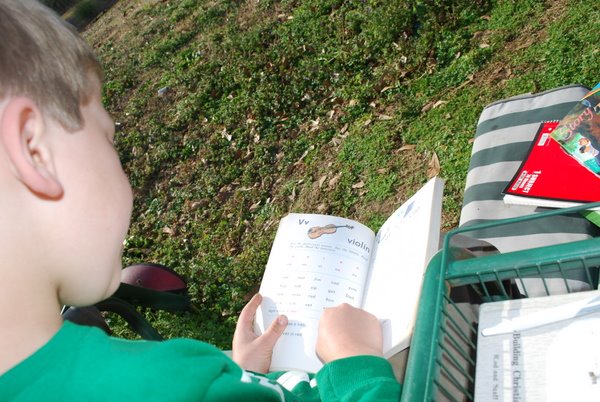
 

This is NOT an anti-education post, it is a real life education post. There are a lot of basics that need to be taught, and that takes discipline and some sitting still behind a book, but should that take the majority of their day? Yes, we need to know how to read, write and do math. History is crucial to knowing where you came from and and where you should be going. Science, geography, music and art have their place too, but most of this can be taught and retained better outside a classroom, or as Mr. Gatto calls it, a cell-block.

If you think about it, it really is a cell-block because you loose your freedom to learn. You are no longer an individual, you are a number among the masses, all moving at the same pace when given permission. And who is giving you permission to move? Who is telling you what you should learn and how you should learn?

Having already raised my children and homeschooling them, then to have little ones in the house again has made things even more obvious to me. With my first go-around with my older kids I was hoping I was right, and now I know with a stronger passion that I am right! ;)

Our 6 year old little boy thinks out-loud, he asks questions from the time his eyes open until he hits his pillow at night. He walks by our side all day and spends tons of time with Jeff as he learns so much about real life; real life that consist of math and science. He is having his questions answered as his natural, God-given curiosity is peaked. His quest for knowledge is being satisfied as he sees the big picture and how it all relates to LIFE! He is learning math and science as he helps in the garden and helps Jeff in his shop. He walks around with his tape measure and measures EVERYTHING!

A real education is a constant lesson in the real world,

and we graduate only when we pass on to our eternal life!

Are you snacking on poisioned fruit?

“It should come as no huge surprise that the secular world is confused and off-base about the identity and calling of women. But what I find distressing is the extent to which (this) has taken hold even within the evangelical world. We see the fruit of that revolution as prominent Christian speakers, authors, and leaders promote an agenda, whether subtly or overtly, that encourages women to define and discover their worth in the workplace, in society, or at church, while minimizing (or even at the expense of) their distinctive roles in the home as daughters, sisters, wives, and mothers – as bearers and nurturers of life, caregivers, as those privileged and responsible to shape the heart and character of the next generation. The feminist revolution was supposed to bring women greater fulfillment and freedom. It was supposed to make us feel better about ourselves; after all, “You’ve come a long way, baby!” But we see the poisoned fruit of the revolution in the eyes and pitiable cries of women who are drowning in the quagmire of serial divorce and remarriage and wayward children; women who are utterly exhausted from the demands of trying to juggle one or more jobs, function as single parents and be active in church; women who are disoriented and confused, who lack sense of mission, vision, and purpose for their lives and who are perpetually, pathetically shrouded in woundedness, self-doubt, resentment, and guilt.”

~Nancy Leigh DeMoss, Biblical Womanhood in the Home

A lively hope…

“…it is called a lively hope because it puts the soul upon lively endeavors.

Hope will make a man pray as for life, hear as for life, mourn as for life,

obey as for life and work and walk as for life.

Hope will not say this work is too hard and that work is too hot;

this work is too high and the other work is too low.

Hope will make a man put his hand to every work.

Hope makes a man more motion than notion;

it makes a man better at doing than at saying.

Hope gives life and strength to all religious duties and services.

A man full of hope will be full of action.

A lively hope and diligent hand are inseparable companions.

Hope will make a man do though he dies for doing.

–Thomas Brooks

Blog Widget by LinkWithin